Sarah-Jane Stratton, Clinical Psychologist with the CRANAplus Bush Support Line, speaks about remote mental health work, motherhood, and the often-unspoken complexities of returning to work after having children.
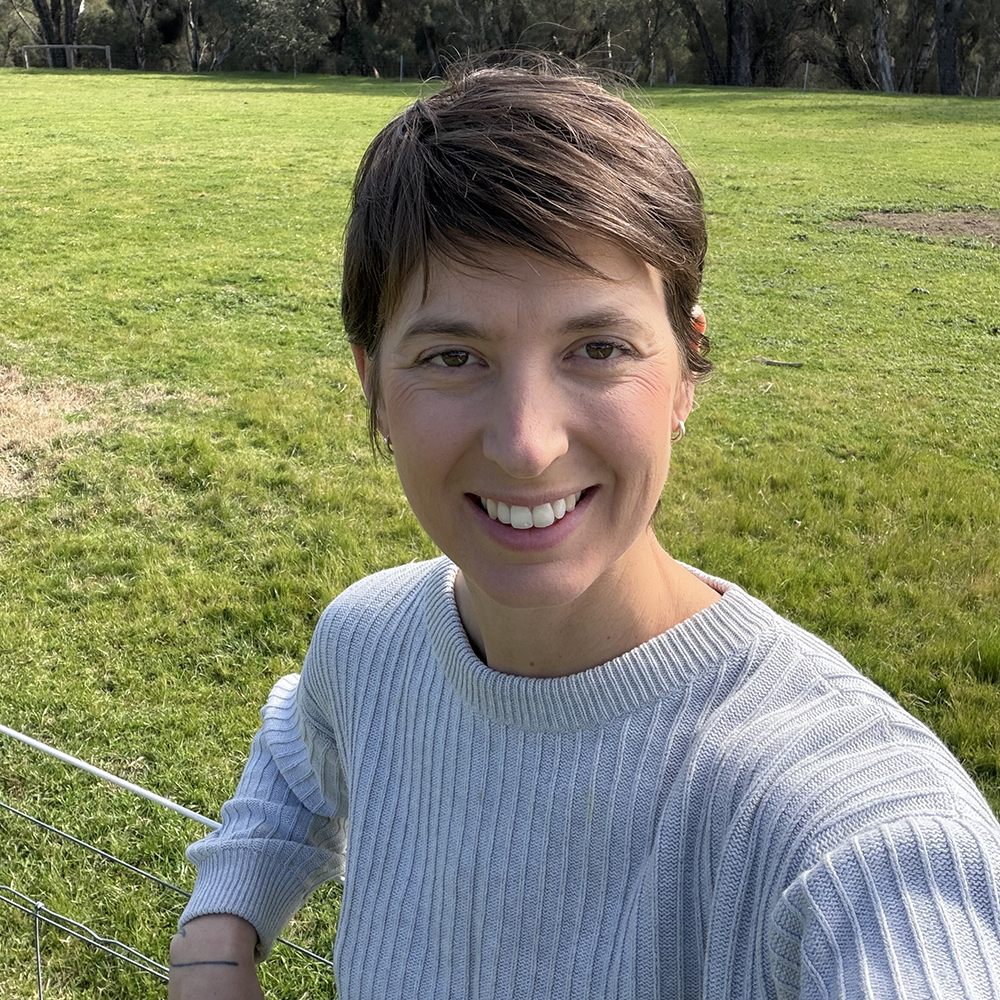
I spent four years living and working as a Child and Adolescent Mental Health Service (CAMHS) Clinician in the Kimberley, remote WA, before relocating to rural WA to be closer to family when we had our first child. I’ve always felt drawn to rural and remote mental health work. There’s something deeply meaningful about the connection that happens in smaller communities. After moving to rural WA, I started as a Clinical Psychologist contractor with the CRANAplus Bush Support Line, supporting rural and remote health workers and their families.
I loved this work immediately because I felt in some way still connected to the more remote parts of Australia through the stories I was hearing. I also believe that our nervous systems talk to each other, so when health workers feel grounded, calm, and supported, they are better able to help others feel safe and regulated, too. And in communities where trauma, loss, disasters, and adversity are not uncommon, this is so important.
I was working with the CRANAplus Bush Support Line, and in a rural WA CAMHS clinic, when I made the decision to step away from the latter. Shortly after, we found out we were pregnant with twins. I took a second stretch of maternity leave and these days I divide my time between my work as a Clinical Psychologist with the CRANAplus Bush Support Line and the unpaid, often unseen work of raising our three young children; a role that has challenged, stretched, and shaped me as much as any professional role ever has.
While every family’s circumstances, choices and opportunities look different, I’m fortunate that this arrangement works for our family at the moment.
For much of my career, I have sat alongside people navigating significant life transitions, helping them make sense of change, loss, identity shifts, and the challenge of adapting when life no longer looks the way it once did. What I didn’t realise was how profoundly I would come to understand these experiences myself through becoming a mother.
I remember sitting in a clinical review at CAMHS, not long after returning to work after having my first child. This space had once felt familiar and energising – but suddenly there was this really strange disconnect. My colleagues were moving through case presentations quickly, formulating clearly, offering treatment recommendations, and I was just drawing blanks and hearing ‘The Wheels on the Bus’ over and over again!
At the time, I remember thinking, “What has happened to my brain?”
But underneath the brain fog, there was this unexpected, quieter kind of confidence. I was able to make decisions more quickly (definitely not because I had more clarity), but because I just no longer had the capacity to endlessly analyse every possibility.
That experience captured something important about early parenthood for me: the strange push-pull of feeling both diminished and expanded at the same time.
Part of me grieved the sharpness and professional identity I once relied on so heavily. But another part of me was growing in ways I didn’t yet fully under-stand. My attention was constantly split between multiple emotional worlds, wanting to be fully present at work while also carrying the invisible mental load of motherhood.
It was only later that I came across the term matrescence – a concept initially introduced by medical anthropologist Dana Raphael back in the 70s and more recently expanded on by Psychiatrists like Dr Alexandra Sacks – to describe the transition into motherhood (Raphael, 1973).
And honestly, discovering that word felt relieving.
Why? Because matrescence explains something we don’t talk about nearly enough: that becoming a mother is not simply an event, but a profound developmental transition. Much like adolescence, it involves biological change, emotional upheaval, identity reconstruction, and loads of disorientation! (Sacks & Birndorf, 2017) Yet unlike adolescence, there is an expectation that women move through it more quietly and without disrupting the rest of their lives.


Matrescence didn’t just reshape my life outside of work, it also began to influence how I experienced my work. Parental anxiety and overwhelm were no longer concepts I understood only professionally; they had become lived experiences. I found myself holding greater compassion for the realities families face and the sheer difficulty of trying to make meaningful changes while already running on empty. Some aspects of the work felt emotionally closer to the surface than they once had.
Parenthood also changed my relationship with energy and time. There was less of both. I became more aware of how unrealistic many expectations – both personal and professional – can be, particularly for parents trying to balance caregiving, work, relationships, and their own wellbeing all at once.
And then there were the quieter challenges. The guilt. Feeling like I wasn’t giving enough at work, while simultaneously feeling like I wasn’t giving enough at home. The exhaustion – not just physical tiredness, but cognitive and emotional depletion. The emotional complexity of daycare drop-offs: holding my child’s separation distress before stepping into a role that involved emotionally holding space for others.
And honestly, one of the most complicated parts has been the joy of motherhood itself. There have been moments when I felt I couldn’t quite admit how much I genuinely enjoy being present for ordinary moments with my kids. At times, it has felt strangely uncomfortable to acknowledge that fulfilment openly – as though loving motherhood too much somehow conflicts with professional ambition or identity.
Over time, I’ve found a few things that have helped.
Understanding matrescence and having a language for why I could feel deeply competent and deeply uncertain at the same time was hugely helpful.
I realised I wasn’t failing to “get back to” being the clinician I had been before kids – I was returning as someone fundamentally different. Expecting myself to move through a major developmental transition unchanged wasn’t realistic.
I’ve also learned the importance of boundaries and sustainability. I don’t access work emails from home. I try to work strategically around my energy levels. I aim for small, achievable goals rather than impossible standards.
And perhaps most importantly, I’ve had to practice offering myself the same compassion I so readily offer other people.
Returning to work after becoming a parent meant letting go of an old measure of success. I could no longer give my work the same singular focus I once had, and initially, I saw this as a deficit.
Over time, though, I realised that my capacity hadn’t shrunk, it had been reorganised, and in some ways, expanded. My energy was now shared across multiple roles and relationships, competing demands, and overlapping emotional worlds. But rather than making me less effective, this has allowed me to approach my work with more intention, perspective, and compassion.
Motherhood has taught me that adapting isn’t about doing everything perfectly. It’s about learning to hold what matters most in a particular season of life. Like the metaphor of juggling glass and rubber balls, the goal isn’t to juggle every ball perfectly, but to recognise which ones are most important in the present moment and give those your attention.
References
Raphael, D. (1973). The tender gift: Breastfeeding. Prentice-Hall.
Sacks, A., & Birndorf, C. A. (2017). Matrescence: Lifetime impact of mothering. Psychiatric Annals, 47(9), 483–486.