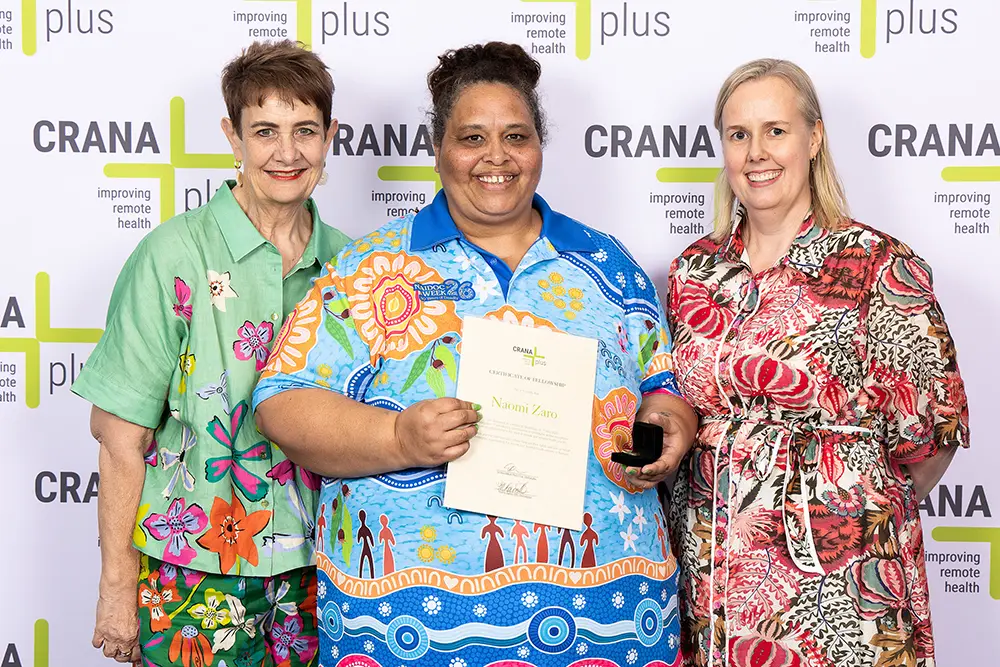
CRANAplus Board member Naomi Zaro has been named a CRANAplus Fellow, recognising her commitment to the organisation and a career focused on encouraging collaboration between nurses, Aboriginal and/or Torres Strait Islander Health Practitioners and other staff in remote clinics.
“Good collaboration involves working together – not just working alongside,” says Naomi, herself a Torres Strait Islander Health Practitioner with years’ of experience as a clinical educator in Aboriginal and/or Torres Strait Islander Health Practitioner training.
“When collaboration, based on mutual trust, works well it means better outcomes for patients, communities and the nursing staff.
“Clinics can feel safe or intimidating,” says Naomi. “If community see everyone’s getting along in the clinic, they’ll be more likely to come.”
Naomi has watched the development of Aboriginal and/or Torres Strait Islander Health Practitioner training over the years, from a role as translators and cultural bridges to continued expansion of their clinical skills, with many choosing to go on to become enrolled or registered nurses.
The role of an Aboriginal and/or Torres Strait Islander Health Practitioner has diversified again, broadening their scope of practice, says Naomi. It has moved from being cultural to clinical and now it looks more holistic, bringing in the social and emotional wellbeing of clients, health promotion and the mental health and wellbeing side of things.
Naomi says a highlight of her work as an Aboriginal and/or Torres Strait Islander Health Practitioner trainer is when her students get the ‘aha’ moment.
“You see that they get it and you just go, ‘Yeah. Job done.’”
For Naomi, however, the quality of care in remote clinics depends less on individual expertise than on what happens between people moving in and out of roles with confidence, respect, and clarity.
“Health literacy within a community is very important, but, too often, people delay visiting clinics because they do not feel comfortable,” she says.
“Sometimes they only come when things have already become an emergency. By then, something treatable may have become serious. A dental infection becomes sepsis. A manageable condition becomes an evacuation.”
In practice, Naomi says ‘dream situations’ she has witnessed are when staff recognise when to lead and when to step back.
“Aboriginal and/or Torres Strait Islander Health Practitioners often become the first point of contact,” she explains. “They can put clients
at ease when they come into the clinic. Then they’ll bring in the nurse when something is outside their scope.”
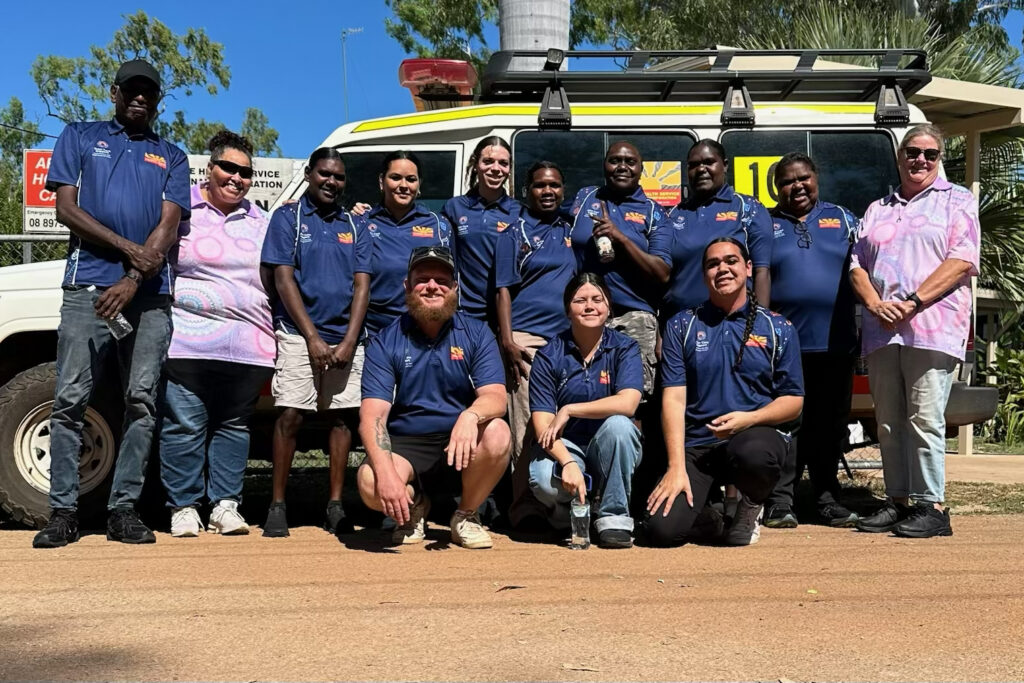
Naomi also outlined situations when a registered nurse, with extensive credentials but little experience in a remote community, recognises the cultural knowledge the Aboriginal and/or Torres Strait Islander Health Practitioner brings to the team.
Naomi says that community activities, such as health promotion and vaccination days, barbecues and school visits help strengthen trust and are a positive way for community members to get to know the nurses. And for nurses to get to know the community.
“Some nurses arrive with a Florence Nightingale mindset, ready to fix all the problems, and quickly,” says Naomi. “But communities don’t work that way. Change
is gradual, repetition matters and trust develops slowly as relationships are made.
“Take your time,” is Naomi’s advice to newly arrived nurses.
“Don’t try to become everyone’s friend in week one. Allow the community to get to know you.”
Workforce realities shape what is possible in remote communities, Naomi acknowledges. There are not enough Aboriginal and/or Torres Strait Islander Health Practitioners to meet demand in many regions, and retention is an ongoing challenge.
Some leave because of family commitments. Others move on after training.
There are also tensions within practice itself. Aboriginal and/or Torres Strait Islander Health Practitioners often carry responsibilities that sit between professional boundaries and cultural obligations – including mandatory reporting in situations where family and community ties are deeply present.
And with registered nurses who go remote, the environment can be daunting, says Naomi. There’s no coffee shop within five minutes. There’s no McDonald’s just down the road. There’s no public transport.
“Nurses arrive in communities from urban hospitals and may have never worked alongside an Aboriginal and/or Torres Strait Islander Health Practitioner,” she says.
“I urge a new nurse in a community to sit down with them and ask questions. It’s an ongoing task to educate about the evolution of the role, and to get others in the workplace to see Aboriginal and/or Torres Strait Islander Health Practitioners as equals.
“I think one of the biggest things is acknowledging that we’re all out there for the same reasons.”