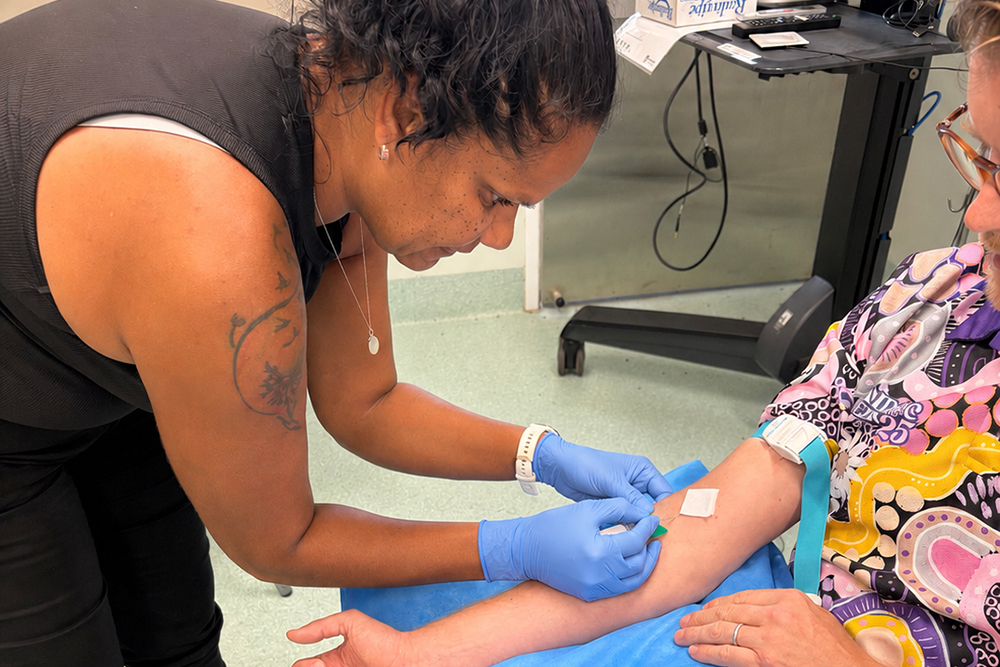
In rural and remote health, we can often wear our competence like a superhero’s cape. We are expected to be capable, steady and solutions-focused. We are the person people call when things fall apart. We are often the first and last point of care across vast distances. Our communities know us personally, and our colleagues rely on us heavily. In this environment, where we can be perceived as superhuman, it can often feel risky to show emotion, uncertainty or limitations.
Yet, healthcare is very much human work. As humans, we experience fatigue, moments of uncertainty, doubt, and emotions such as frustration, fear, and grief. Add to this the weight of the unique challenges of rural and remote healthcare, such as under-resourcing, isolation, blurred boundaries etc., the general health culture often encourages us to “be strong”, “keep going”, or to “push through”, to our detriment.
Whilst stoicism has long been an assumed quality of healthcare workers, particularly in rural and remote areas, research has consistently shown that suppressing or avoiding emotion increases cognitive load, physiological stress and burnout, reduces empathy, and impairs clinical decision-making. In contrast, when we acknowledge and allow ourselves to experience our feelings, it helps us process them more quickly, thereby reducing physical and mental load and long-term stress, and enhancing our self-awareness and trust. It also fosters deeper connections with/within ourselves and others, helping us to be more present for our patients/clients and our colleagues.
This Mindful Monday invites you to do something quite radical: give yourself permission to be human at work.
This doesn’t mean being suddenly overwhelmed by emotion, venting inappropriately, oversharing personal details, or abandoning your professional boundaries. It’s about acknowledging that you are a whole person, doing a sometimes incredibly difficult job, and then choosing how to respond to those internal experiences thoughtfully and without self-judgement.
In practice, ‘permission’ is not a one-off process; it is continual. Rather than thinking you need to come across as someone who knows all the answers and is unaffected by the difficult situations you face, you might try saying honest phrases that reflect your inner experiences, such as, “I don’t have the full answer yet, but I will find out,” “Can I get back to you on that? I would like to find out more first” or “This is a complex situation and I need to pause and think about it,” or even “I’m at capacity today, how can we prioritise?”
When it comes to your self-talk (which is just as important as, if not more than, what you say to others), we need to be just as open, honest and reflective. Instead of immediately, and often subconsciously, jumping into self-criticism, you could try saying “It’s ok if I don’t have all the answers today,” “It’s ok that this is affecting me deeply,” or “I’m tired, I’m not at my best today, and it’s ok.” Give yourself the grace you would extend to others.
Mindful practices you can undertake to support permitting yourself to be human at work include:
Capacity mapping. At the beginning of each day, silently assess your emotional capacity (low/medium/high), your cognitive load (light/moderate/heavy) and your physical energy (low/steady/strong). If your capacity is low in one area, you might need to adjust where possible, such as making extra time for documentation or seeking input earlier rather than later. Self-awareness is not an indulgence, but rather clinical risk management.
The reset check-in. In between seeing patients/clients, take three slow, intentional breaths, ground your feet into the floor, and ask yourself, “What am I feeling right now?” “Where do I notice it in my body?” and “What do I need in this moment?” This is not about trying to fix anything, just noticing. This practice helps to reduce the intensity of any unprocessed stress.
Name what you’re carrying. When something difficult happens (e.g. a colleague is critical, a patient deteriorates, or a decision is weighing on you), try naming the emotion without judgment. Rather than telling yourself something like, “I’m weak for feeling this,” instead say, “I notice I’m feeling sad,” or “I’m noticing some anxiety here.” By labelling the feeling, we can reduce its intensity by putting some cognitive distance between us and it. We can also recognise its temporary nature and acknowledge that we are experiencing it in this moment.
Using “both/and” language. We can be both scared and competent at the same time, so try holding dual awareness next time uncertainty arises. For example, you could say, “I feel unsure, and I am competent,” or “I care deeply, and I cannot fix everything.” This reduces black-and-white or all-or-nothing thinking and protects us against self-criticism.
Professional boundary breath. Before entering a difficult situation or interaction, inhale “I bring my skills and care” and exhale “I do not need to be perfect”. This helps anchor you in compassion without priming you for self-sacrifice.
Giving yourself permission to be human at work doesn’t erode standards; it protects them. It should also mean normalising peer support, clinical supervision, and advocating for systemic change. It acknowledges that you do not have limitless availability, and that you have clear boundaries to help protect your health and wellbeing, which, in turn, supports your sustainability at work.
Communities don’t need invulnerable health workers. They need steady, thoughtful and well-supported humans providing them with the best care they can. Practice bringing your humanity to work every day.
Be kind,
Dr Nicole Jeffery-Dawes (she/her)
Senior Psychologist, Mental Health & Wellbeing Service