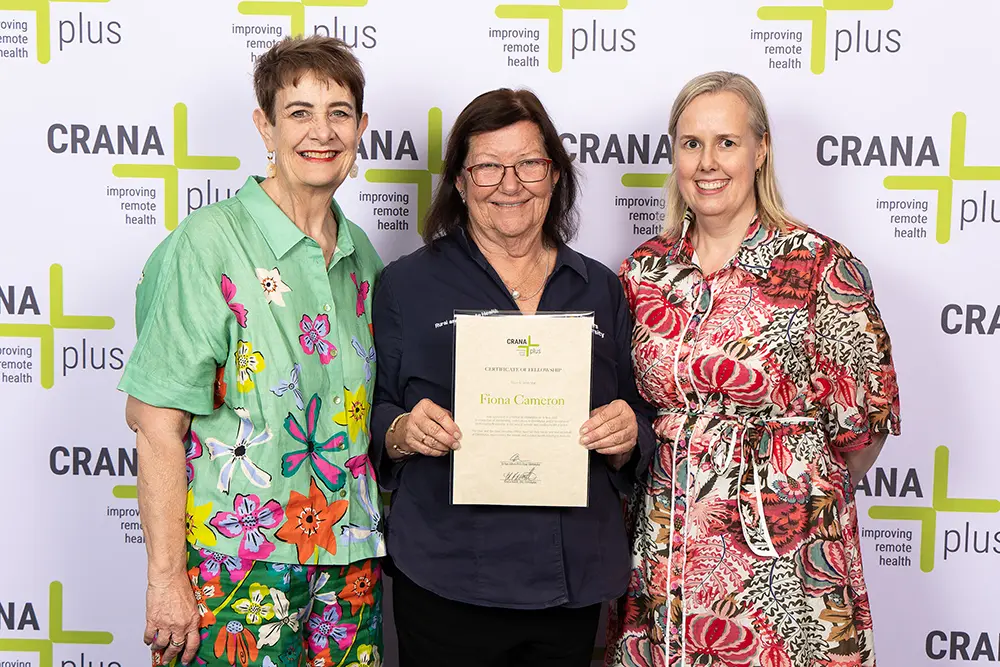
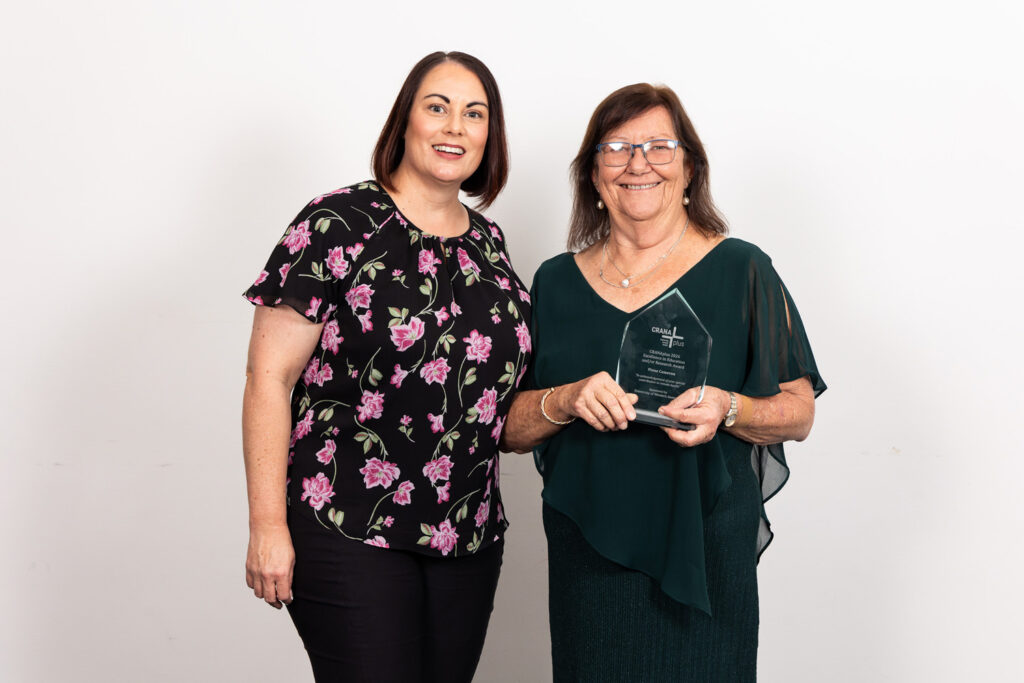
In 1980, Fiona Cameron arrived in Cape York with a shortwave radio, guitar and little remote experience. More than 40 years later, her work as a lecturer on Flinders University’s Remote Health Practice Program has earned her two major honours at the 2026 CRANAplus Conference: the Excellence in Education and/or Research Award (sponsored by the University of Western Australia) and CRANAplus Fellowship.
In 1980, Fiona walked into the Department of Aboriginal and Islander Affairs in Brisbane and asked: “Do you have any jobs?” Within a few weeks, she was working in Cape York.
“It was an amazing transition from Brisbane,” she says.
“There was no telephone and no TV. You had to write a letter to the supermarket to Cairns to say what you’d like sent on the plane.”
She wasn’t yet a midwife, a gap she quickly felt. Pregnant women had to leave their communities to give birth in larger towns or cities, she explains – but it didn’t always work out that way.
“A lot of the women wouldn’t go, or they’d go and they’d come back, and they’d present in the middle of the night with a baby about to be born,” she recalls.
“That was frightening for me, but I did learn a lot. That was one of the reasons I said I’m never going remote again until I’m a midwife.”
Fiona returned to study, worked in larger hospitals and gained her midwifery qualifications before returning to remote health for good in 2000.
Since then, Fiona has worked in remote NT, the Torres Strait, the Kimberley, Cape York and Central Western Queensland, in clinical, education and senior leadership roles.
Four years ago, she took up her current post as Lecturer in the Remote Health Practice Program at Flinders University in Alice Springs. It was a full-circle moment. She’d first heard of the program decades earlier, working in the Torres Strait as a young nurse.
Echoing the sentiments which gave rise to the course in the 1990s, Fiona says, “The history of remote nursing has been like – people just get thrown in and you sink or swim.
“So that’s why, delivering education, going out with them, supporting them, is so important.”
Due to the connections she has formed through years of work in remote places, Fiona has been able to introduce a series of guest lecturers who are specialists in the field.
“It probably gets a bit boring listening to me!” she laughs.
“I’ve been lucky because I’ve been in Alice Springs now since 2009 and working in primary health care. So I built all those networks over the years.”
She uses the same networks to help students find their footing. “I try to help remote nurses think about how they’re going to develop their career, what directions to go,” she says.
“They do a two-week placement in a remote health centre, and if they need to, I organise that for them with someone in Central Australia.
“We now have a program where if they’ve got suitable qualifications that the Department of Health will take them on for a longer contract and pay them to do the placement.”
She emphasises that the program teaches so much more than just clinical skills, covering areas like self-care and safety.
Despite the positive impact she has had, Fiona was still shocked to be recognised with the Excellence in Education and/or Research Award – and to be bestowed CRANAplus Fellowship at the same conference.
“Dallas [from CRANAplus] had my CV on stage and was reading everything I have done,” she recalls. “And I’m going – oh my goodness, I haven’t really done all that, have I?”
When asked what the proudest moment in her career is, Fiona shares a clinical anecdote – one which testifies to the importance of being prepared.
It happened when she was working in the NT as an educator. One day, she went out to the clinic only to find her student was off sick.
“There were two remote area nurses with me, and we had this fellow come in and have a huge myocardial infarction. He arrested, and we saved him,” she recalls.
“I couldn’t believe it. By the time the RFDS came, the man was sitting up in bed like nothing had ever happened to him.”
It’s for moments like these that Fiona is preparing the next generation.