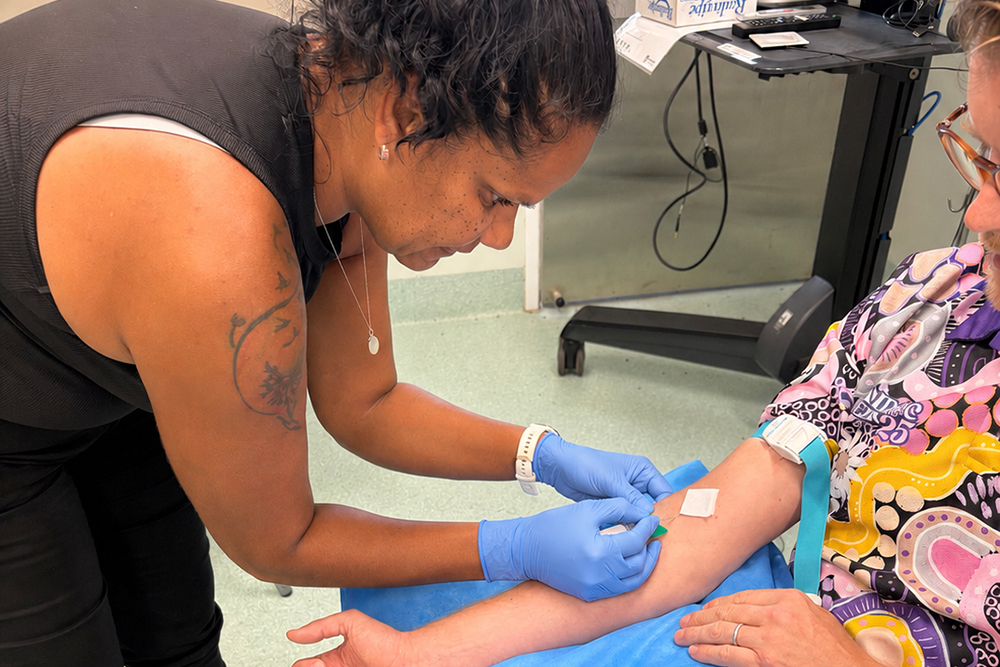
The 2025 Independent Health and Aged Care Pricing Authority (IHACPA) Conference in Adelaide was a chance for health professionals and stakeholders to come together to address resilience and sustainability of the growing care economy. CRANAplus supported Fellow Sabina Knight to attend to ensure rural and remote representation. Sabina shares her experience.

I attended the 2025 IHACPA Conference from 5–7 August in Adelaide. The theme of the conference was ‘Integrating resilience in the care economy – exploring the role of pricing’. There was a range of impressive international speakers, and the workshop program was comprehensive and offered skill development and insights into innovation and research underway.
One project that caught my eye was the Australian Non-Admitted Patient Classification Project to develop a new patient-centred classification system.
Data was procured from state and territory Electronic Medical Record (EMR) systems, so may well have some gaps, as we know not all states and territories have EMR.
They looked at hospital outpatients, community-based clinics and patients’ homes, breaking them into two tiers and four groups – procedures, consults, diagnostic services and allied health and nursing interventions.
They were comprehensive, mutually exclusive and consistent.
It really prompted what the EMR misses and why it matters. It also postured that EMR should be considered as providing operational insight, not just as a medical record.
Clearly, clean and correct data matters. This may well impact positively on remote health down the track.
A key theme throughout was that pricing needs to have clear outcome-based models that ensure patient-focused care, are flexible, integrated and evidence-based, and address workforce challenges.
Outcomes payments should incentivise innovation and reduce fragmentation.
As you would expect, there was a focus on productivity and agreement that it really does matter, but, unbelievably, there isn’t an agreed definition on what productivity is, so defining it and measuring it is central to the future of the care economy. Overseas examples haven’t defined it either!
Amol Navathe from the University of Pennsylvania spoke a lot about value-based care and gave a couple of international examples. It was agreed that the care economy workforce has been underdeveloped over time and ignored at our peril. This creates a moral hazard. Financing is segregated from health and social care, and motivators in public and private care are quite different.
It was acknowledged that small changes matter a lot in quality-of-life years, which may be increased and then contribute to economies/GDP bottom line. Where efficiency decreases, health costs rise.
I was pleased to see that they were promoting that pricing must ensure equity of access, value-based care, workforce and resilience. There is no consensus in the USA on what comprises value-based care. I’m not sure that we have consensus here either. However, and worth noting, they have had ten years of testing innovation,
and three models of value-based care have emerged: population-based model, advanced primary care model, and episode-based models.
Amol spoke about defining value with intention, which is critical to define the objectives that policymakers seek to accomplish. We need to identify the areas to focus on, and if we don’t pay for prevention, we don’t get it!
The new aged care act puts older people at the centre of care and will change how the sector operates. It has codified kindness, compassion, dignity, respect, rights etc. but not funded any difference. There will have to be a rebalancing of funding, and nursing has a strong interest in this. Over and under-funding have perverse effects.
Stan Grant presented a powerful reflection of his family experiencing the aged care system for the first time, in that Indigenous people have been excluded by society until relatively recent times – kept out of the system until recently, and as they age. He spoke about the experience of holding a parent’s vulnerability and how that is shocking to you when you are used to them being strong leaders.
He acknowledged that across Australia, First Peoples are facing challenges in facing the intimacy of care, and that caring for parents/loved ones is their last lesson for us. History is a touch away for this group. Born on a mission, memories of segregation, exclusion, beatings, being taken away and life on the move is a common experience and now, for those who have survived into older age, aging is a new experience we otherwise take for granted.
I feel like I have a much stronger handle on what the work ahead is of the IHACPA. Our pricing needs to take into account rurality, flood, fire and drought and build resilience.
Medicare was our last big policy reform that was research-based. We should be not only producing evidence but lobbying for more evidence-based decision-making. There is an opportunity for IHACPA and others to convene a discussion and describe value.
Innovation is easy and translation is hard. Transformation isn’t rocket science – it’s much harder!