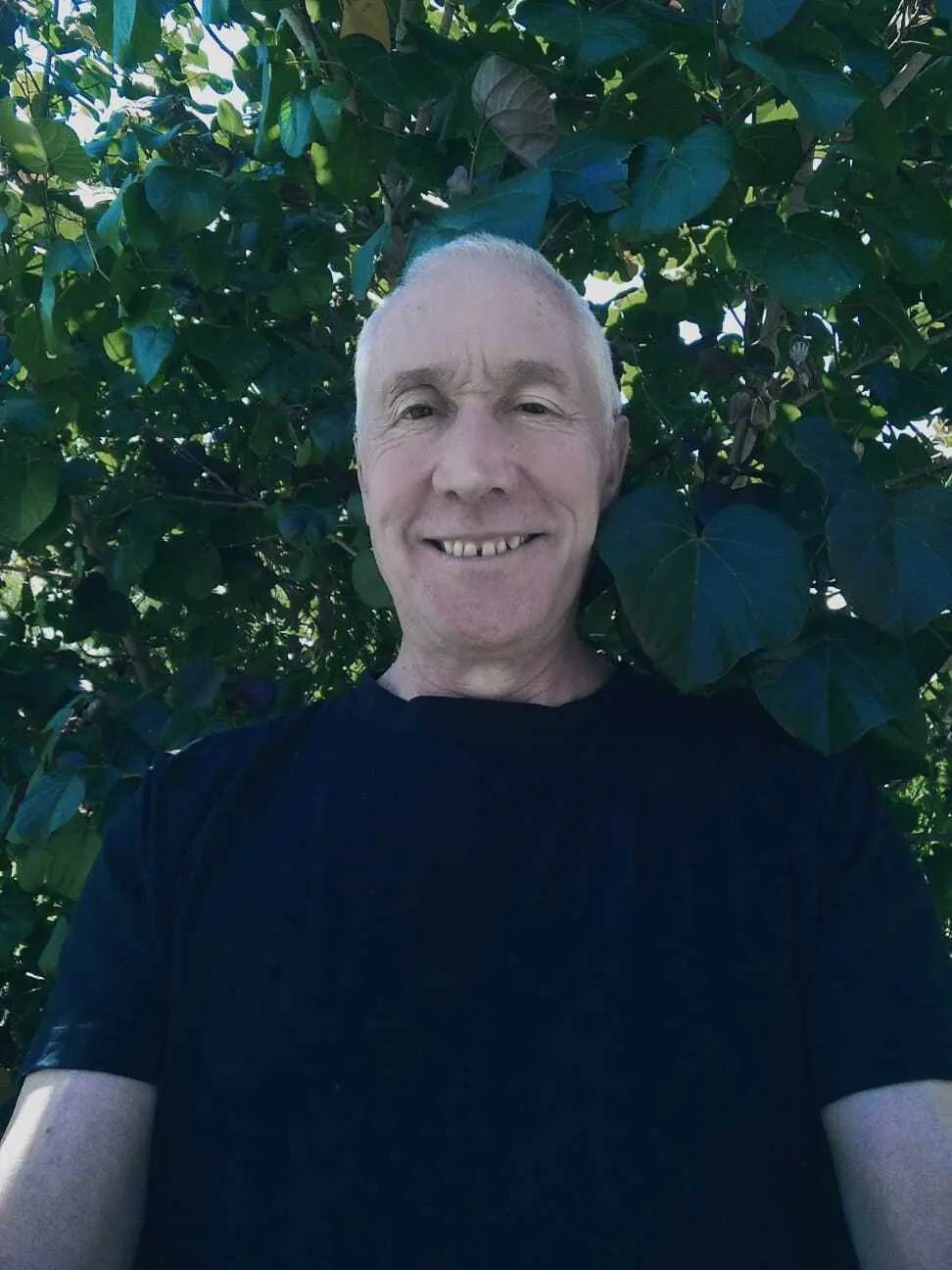
“Sitting around a campfire south of Agadir in Morocco one night someone asked me what life was like for Indigenous Australians. I was nineteen and I said something inane like ‘Life is good for all Australians. We come from the land of milk and honey.’ When I got back to Australia I promised myself I would find the answer to that question. The truth was, I had no idea.”
“In 1975 I travelled up North from Adelaide on the Stuart Highway and then turned left to see Uluru. It was here I met my first Indigenous Australian. I had been in the country since I was five years old and, although I may have met indigenous people before, no-one ever ‘owned up’ in our conversations. This man was different, he sat in the sand with the head of an axe in his hand carving a boomerang out of hard Central Australian wood. He wore a red headband and his hair stood out above it. He looked as ancient as the rocks around him. There was a boy with him and when I tried to talk to this busy man, the boy told me that he spoke no English. I was amazed that there were other languages in Australia that I didn’t know about. After sharing my sandwich and some milk with the young boy I made the decision that I wanted to work with these people. It took me four years to get accepted into a nursing school in Bairnsdale, Victoria, where I did Enrolled Nursing, and another 10 years to get my degree and my first posting in an Aboriginal community, Jigalong, in the Pilbara region of Western Australia. And that’s where I am sitting writing this now, almost 30 years later, having come and gone over three decades.
“I still don’t have the answer to that question posed back in Morocco. We have better policies, better buildings, better training, better cars, better referral pathways, better support, better funding than when I started nursing all those years ago – but we don’t really have better health outcomes in many areas. Children are healthier, but still lag behind other Australians. The burden of chronic disease is still huge but truth is until we get the trauma of colonisation healed and we are walking side by side with community members assisting them in self care and the achievement of their own life goals we are playing with numbers that only we understand.”
“We are talking about people born in the desert. People still walking around now with stories of when they were children, stories of people being fed salt so they would lead the cattlemen to waterholes. Stories still in living memory.
“The Mardu are an amazing people. They don’t carry a lot of bitterness.”
After his first one-year stint in Jigalong in 1991-92, Stephen returned in 2016-17, and again 18 months ago. “When I first came out here, we used to take folk out bush and collect wood, they’d take us to waterholes,” he says. “It was a really nice relationship and my aim was to build trust to provide the best health care.”
Times have changed – and not for the better, says Stephen. “The business model has shifted, it’s become an ‘Aboriginal industry’. Relationships are put to the background.
Stephen, who has added post graduate qualifications in mental health and child care to his skills, claims he has stopped studying – but he’s still adding to the long list of CRANAplus and other courses he’s attended and participated in. It was that impressive list that saw him being made a Fellow of CRANAplus 10 years ago.
Stephen fears that the dominant society is too arrogant to bend for changes to happen soon. “In every country that’s been colonised, it’s been capitalism working at its best. Stealing the land and resources of the Indigenous people and using it to make the colonisers rich. And we love it to this day, because we are part of the dominant culture.”
But there still lies that question. “How do we heal the trauma of Terra Nullius, and all the other policies and interventions that have caused such deep and hurtful wounds on the Aboriginal Nation and its peoples?” he asks. “I don’t feel it is my place to have answers. Show compassion, love, engagement and a willingness to stop and understand and reach out an uplifting hand of national inclusion, is really all I can say.”