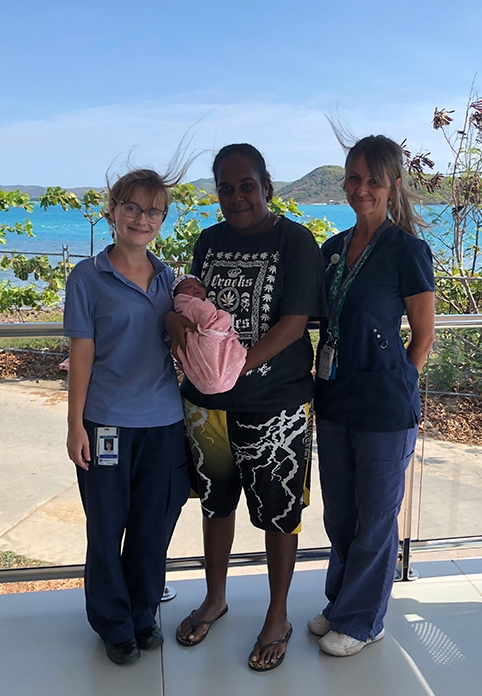
Standing on the balcony of Thursday Island Hospital, Maxine Lenehan can see across a few kilometres of ocean to Horn Island, Prince of Wales Island and Friday Island.
If she was to squint while gazing out at the green mountainous headlands, she might almost be in Sydney, where she used to live in the western suburbs.
But when she steps inside again, it will be into a different world: her new life as a midwife working in the Midwifery Group Practice (MGP) on Thursday Island.
The MGP based on the island services the populated outer islands and five indigenous communities on Cape York.
If deemed safe to give birth on TI, women travel to stay in local accommodation when they are 36 weeks pregnant and then birth in the hospital’s maternity suite.
“All women receive MGP care,” Maxine says, “meaning they are engaged in their own healthcare. We have a continuity of care philosophy, where the women get to know the team of midwives looking after them.
“Three midwives look after the Torres Strait islands, and three look after the communities on the Cape. On TI there is also a midwife 24/7 on shift in the hospital.
“I care for women on the eastern cluster of islands, including Murray Island, Darnley Island, Stephens Island, Yorke Island and Yam Island.
“We make day trips, often by helicopter or fixed wing, to the islands we cater for, and have appointments with women at the health clinics.
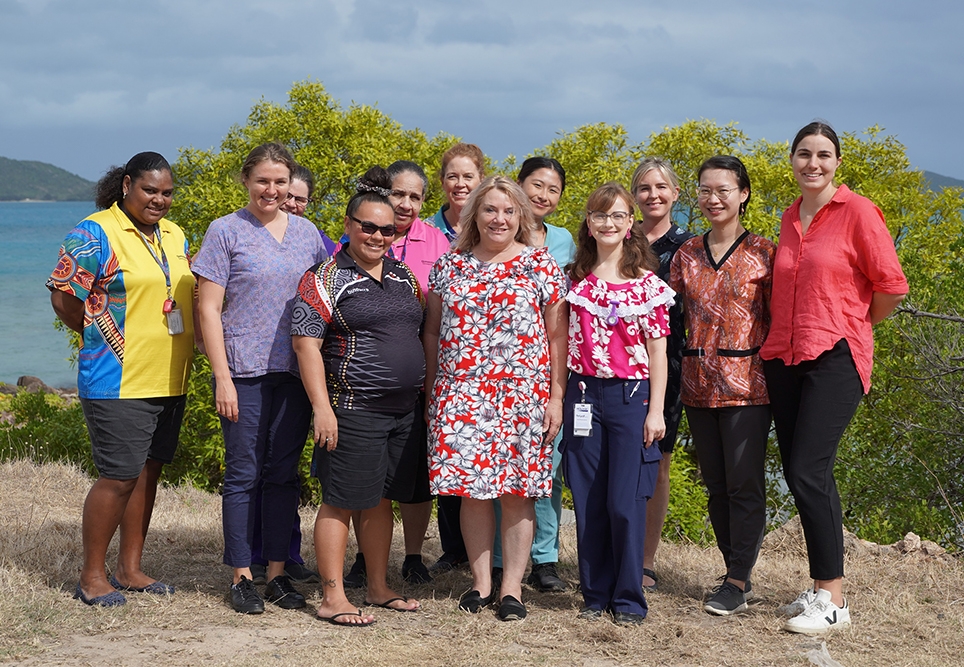
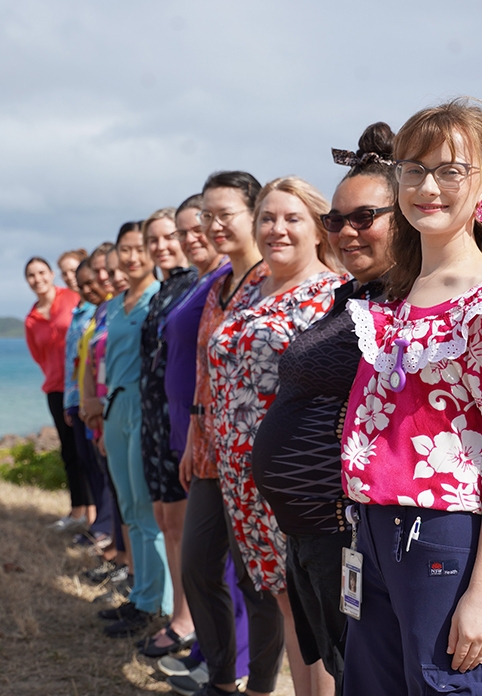
“Having the presence of a midwife who services communities, who comes to women rather than the women having to come to hospital – that presence and continuity is great for building trust and relationships.”
Before this role, Maxine worked in Westmead Hospital in Sydney for five years, beginning with a year of shift work before four years within the Midwifery Group Practice.
“But it’s always been a goal of mine to move out of the city,” she says.
“I’ve been here 11 months now; I’ve stayed here and loved it. It was definitely a culture shock – getting my head around the change in lifestyle. But it was the most welcoming place and I’ve been really well supported.
“I’m glad I got to start out as one of the shift work midwives, to understand the hospital, the processes, before moving into MGP.
“I have had a lot of educational opportunities here. For example, I did a Strength with Immersion (SwIM) program in Townsville Hospital in the neonatal intensive care unit.
“It was incredible to see the other side of the story, to understand what happens when the baby gets to Townsville [in the case of a medivac].”
The biggest change for Maxine since she started working on TI has been the need to consider logistics, not just clinical care.
“On the mainland, in urban and some rural locations, when you need supplies or assistance, it is often just a matter of a drive away,” Maxine says.
“Here, a woman may go into premature labour or her waters may break prematurely, and if she is on the outer islands, it usually requires a helicopter flight or tasking the RFDS. And because of where we are, in the tropics, sometimes the weather means the helicopter can’t fly or land for a while.
“When I was doing shift work as a midwife [on TI], sometimes the staff on the outer islands would have women present who may be in premature labour so we, along with a doctor, would support the RANs in the clinic, who have maternity training but are not necessarily midwives.
“We would talk to them over telehealth, and there was one instance where a woman from one of the outer islands was in labour. She was tasked to come to TI, but in the meantime, over telehealth, myself and the GP obstetrician provided advice on how to care for her.
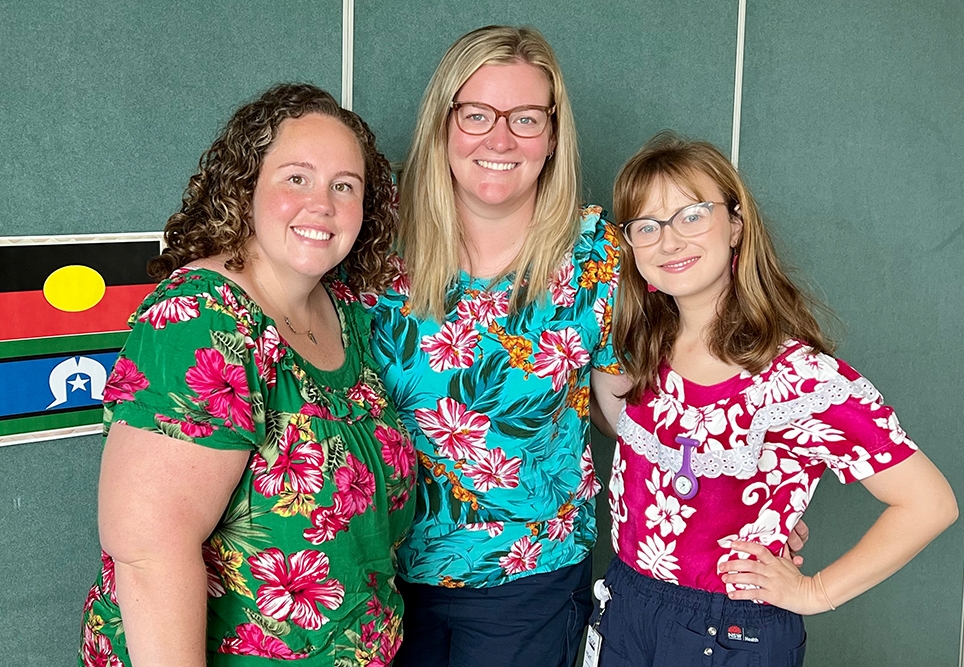
“Providing midwifery care over the camera was daunting, but it was a good outcome for all.’’
Maxine regularly provides care in a cross-cultural context and she acknowledges the vital role played by Torres Strait Islander assistants in midwifery and nursing, including Margaret and Flo, who have almost 60 years of experience between them.
“Having that cultural connection is highly important for health promotion and for bridging the gap between [non-Indigenous] midwives and the local women, who have respect for [Torres Strait Islander] health workers and midwives,” Maxine says.
“They have cared for generations of babies; they are part of the community, and understand the culture, and the cultural differences. Sometimes they also support women in labour, when these women do not have their escort or support person with them for birth, because they are working back home and cannot take a month off to be on Thursday Island.”
Being able to observe and learn from women while delivering cross-cultural care has been one of the most rewarding aspects of the job for Maxine.
“Tides are something that impacts your work, your life, whether you can get out on the water, and there is a cultural belief, strongly held by the community, that tides also impact whether or not a woman is going to labour and when she will give birth,” Maxine says.
“Women will look at the change of tides, which are a lot less predictable than on the east coast. One of the beliefs is that if the tide is coming in, their labour will be fast and strong, and they’ll give birth soon. If the tide is out, their labour will be slow and prolonged, and things won’t progress until the tide turns.
“I have noticed that if the women say, ‘the tide is coming in around this time, this is when I’ll give birth’, then they are right every single time. That’s been pretty incredible.”